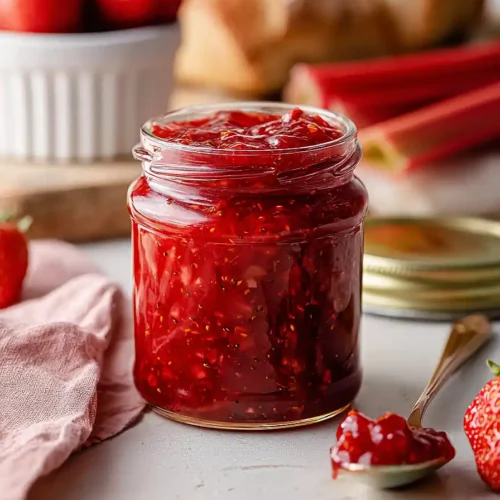
Tangy Strawberry Rhubarb Vanilla Jam
Delicious Tangy Strawberry Rhubarb Vanilla Jam recipe with step-by-step instructions.
Ingredients
- 2 lb rhubarb (trimmed and cut into 1/2-inch pieces)
- 1.5 lb strawberries (hulled and halved for better texture)
- 3.5 cups sugar (I always use Domino granulated sugar)
- 3 tbsp lemon juice
- 1/4 tsp salt
- 1 tsp vanilla bean paste (I prefer Nielsen-Massey pure vanilla extract)
Instructions
- Combine the trimmed rhubarb, hulled strawberries, and sugar in a large bowl, stirring gently to distribute the sugar evenly throughout the fruit. Cover and refrigerate for 12 to 24 hours—this macerating period allows the fruit to release its natural juices and sugar to dissolve, which creates better texture and flavor development in the finished jam. I find that starting this the night before makes the cooking process much faster and more efficient the next day.
- While the fruit macerates, wash your jam jars thoroughly with hot soapy water and rinse well. About 30 minutes before you plan to cook, place the clean jars in a pot of simmering water to warm them—this prevents thermal shock when you fill them with hot jam. Place a small ceramic plate or glass dish in your freezer at the same time; you'll use this to test the jam's set later. Having everything ready means you won't rush the critical moment when the jam reaches the right consistency.
- Transfer the macerated fruit mixture (including all the liquid that has accumulated) to a large, heavy-bottomed pot. Add the lemon juice and salt, then bring to a boil over medium-high heat. Once boiling, continue cooking and stirring frequently for about 10 minutes as the fruit breaks down into smaller pieces and the mixture begins to thicken slightly. The fruit will transition from distinct pieces to a chunky sauce-like consistency.
- Continue cooking the fruit mixture over medium-high heat for another 22 to 25 minutes, stirring occasionally to prevent sticking and ensure even heat distribution. The mixture should darken slightly and become noticeably thicker as water evaporates and the pectin in the fruit sets. I like to use a candy or instant-read thermometer to check when it reaches 212°F (100°C), which indicates the proper jam consistency, but you can also rely on the visual cues and plate test.
- Remove the pot from heat and perform a quick set test: place a small spoonful of jam on your cold plate from Step 2 and let it cool for 30 seconds. Push it with your finger—if it wrinkles slightly and doesn't run back together, it's ready; if it's too thin, return the pot to heat for another minute or two. Once the jam reaches the desired consistency, stir in the vanilla bean paste or extract, combining it thoroughly throughout the jam.
- Carefully remove the warm jars from the simmering water and place them on a clean kitchen towel. Using a clean ladle or funnel, fill each jar with jam, leaving exactly 1/4 inch of headspace at the top—this space is essential for proper sealing. Wipe the rim of each jar clean with a damp cloth to remove any jam residue, then secure the lids tightly.
- Place the filled jars back into the pot of simmering water, ensuring they are covered by at least 1 inch of water. Bring to a rolling boil and process for 10 minutes. Turn off the heat and leave the jars in the hot water for 5 minutes, then carefully remove them using jar tongs and place them upright on a clean towel to cool completely at room temperature. As they cool, you'll hear the satisfying 'pop' of each lid sealing—this indicates the jam is properly preserved and shelf-stable.