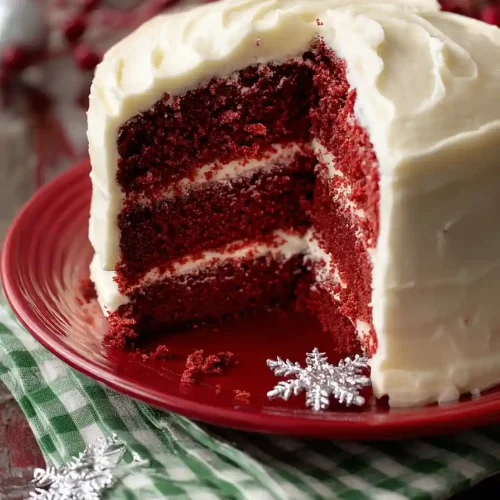
Festive Southern Red Velvet Christmas Cake
Delicious Festive Southern Red Velvet Christmas Cake recipe with step-by-step instructions.
Ingredients
For the cake:
- 1 cup whole buttermilk (room temperature)
- 3 large eggs (room temperature)
- 1.75 cups sugar
- 1 tbsp white vinegar (activates the baking soda)
- 1 tbsp vanilla extract (for best flavor)
- 1 cup vegetable oil (or any neutral oil)
- 2 tbsp unsweetened cocoa powder (for deep color and subtle richness)
- 1 tsp baking soda
- 2 tbsp red food coloring (gel or liquid, for vibrant red color)
- 2.5 cups all-purpose flour (I use King Arthur all-purpose flour)
- 3/4 tsp kosher salt
For the frosting:
- double-batch cream cheese frosting (I use Philadelphia cream cheese for smoothest texture)
Instructions
- Preheat your oven to 325°F and position racks so you can bake three cake pans simultaneously. Grease three 9-inch round cake pans generously and set them aside. Gather all ingredients and measure them into separate bowls—this is especially important for baking because you need everything ready to go. Make sure your eggs, buttermilk, and oil are all at room temperature, as this helps them emulsify properly and creates a more tender crumb. Room temperature ingredients combine more evenly, which is crucial for red velvet's signature silky texture.
- In a stand mixer, combine the flour, sugar, cocoa powder, baking soda, and salt on low speed for about 30 seconds, just until everything is evenly distributed. The cocoa powder is key here—it creates the deep chocolate undertones that make red velvet distinct from a regular cake. Don't overmix at this stage; you just want the dry ingredients incorporated. This creates the base mixture that will be ready to receive the wet ingredients.
- With the mixer running on medium speed, slowly pour in the oil while mixing the dry ingredients from Step 2 until the mixture resembles coarse sand—this takes about 1-2 minutes. This step is crucial because it coats the flour with fat, which creates a more tender crumb and helps prevent gluten development. Then add the eggs one at a time, beating for about 30 seconds after each egg until fully incorporated. I like to pause between eggs to scrape down the bowl, making sure no dry pockets remain. This creates an emulsion that makes the cake incredibly moist and velvety.
- With the mixer on medium speed, add the vanilla extract, white vinegar, and red food coloring, beating for about 1 minute until the batter is uniformly colored and fully combined. The vinegar reacts with the baking soda to create lift and also adds a subtle tanginess that enhances the cocoa flavor—don't skip it. The red food coloring should be evenly distributed for that iconic color, so take time to mix it in thoroughly. Finally, add the buttermilk in two additions, mixing on low speed for about 30 seconds after each addition until just combined. The batter should be smooth and pourable at this point.
- Divide the batter evenly among the three prepared pans, filling each about two-thirds full. Place all three pans in the preheated 325°F oven, spacing them evenly on the racks for even heat circulation. Bake for 18 to 22 minutes, until a toothpick inserted in the center comes out with just a few moist crumbs—be careful not to overbake, as red velvet cakes can dry out quickly. The cakes should be springy to the touch and pull slightly from the sides of the pan when done.
- Remove the cakes from the oven and let them rest in their pans for exactly 5 minutes—this allows them to set slightly while still warm, making them less likely to crack when turned out. After 5 minutes, run a thin knife around the edges of each pan and carefully turn the cakes out onto wire cooling racks. Let them cool completely to room temperature, about 1-2 hours, before frosting. I never frost a warm cake because the frosting will melt and slide off; patience here makes all the difference in a beautiful finished cake.
- Once the cakes are completely cool, prepare your double-batch cream cheese frosting, making sure it's smooth and spreadable—Philadelphia cream cheese works best because it's less grainy than other brands. Place the first cooled cake layer on your cake stand or serving plate and spread a generous layer of frosting on top, about 1/2 inch thick. Stack the second cake layer on top and repeat, then crown with the final cake layer. Frost the top and sides of the assembled cake with the remaining frosting, using an offset spatula for a smooth, professional finish. For a festive look, add any holiday garnishes you'd like before serving.